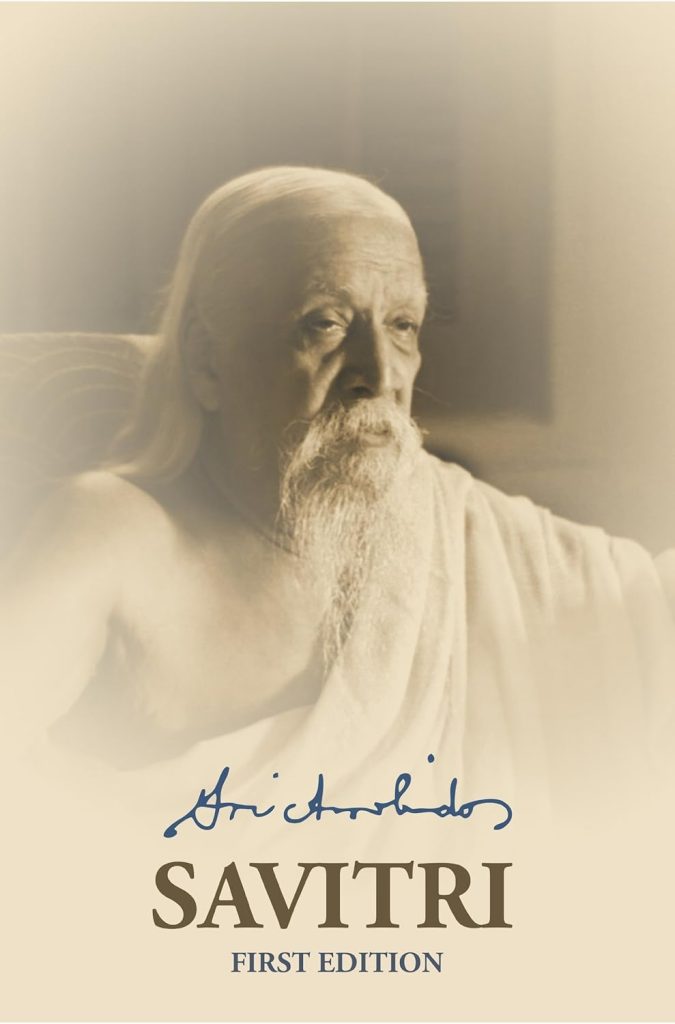
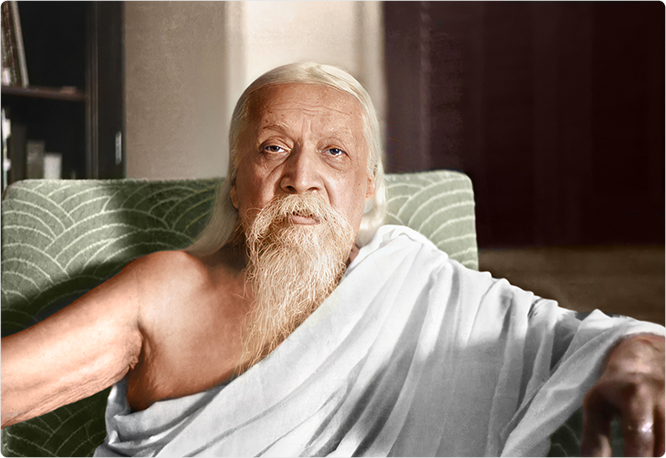
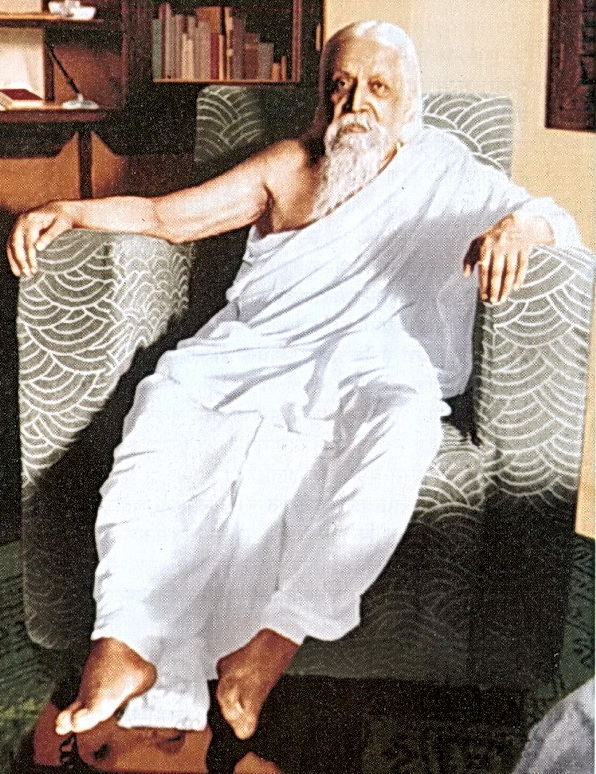
Sri Aurobindo
A Freedom-fighter, Poet, Philosopher, Mahayogi
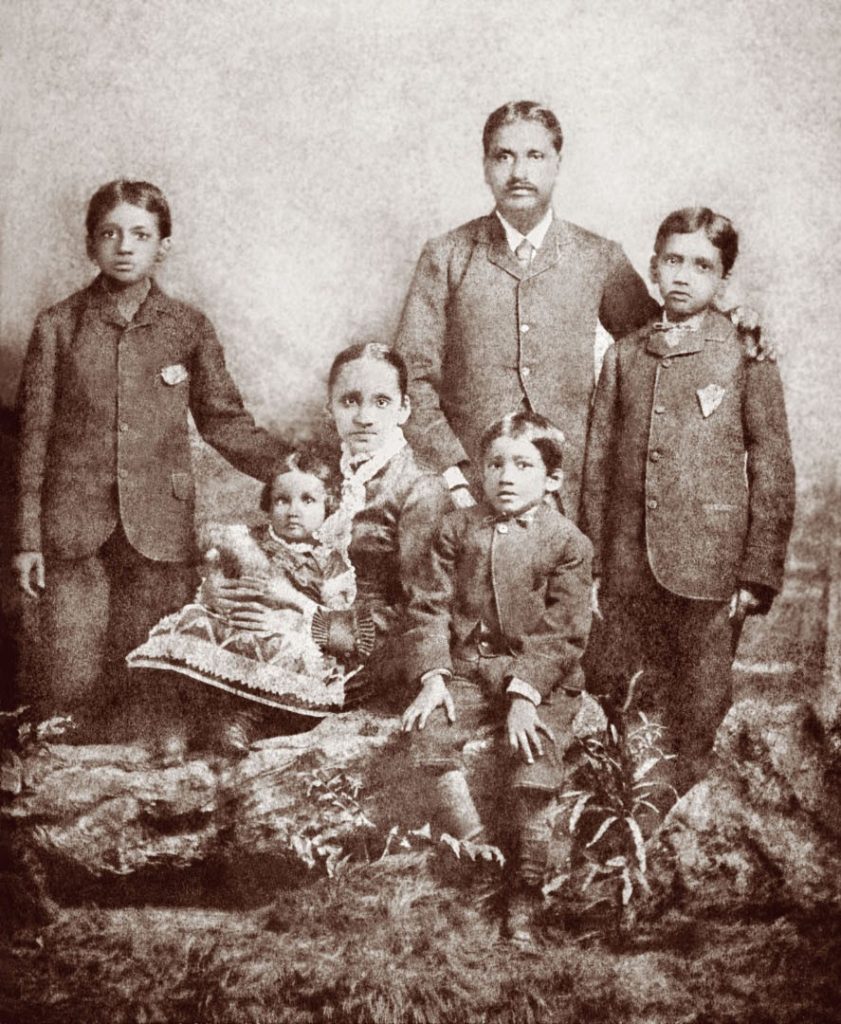
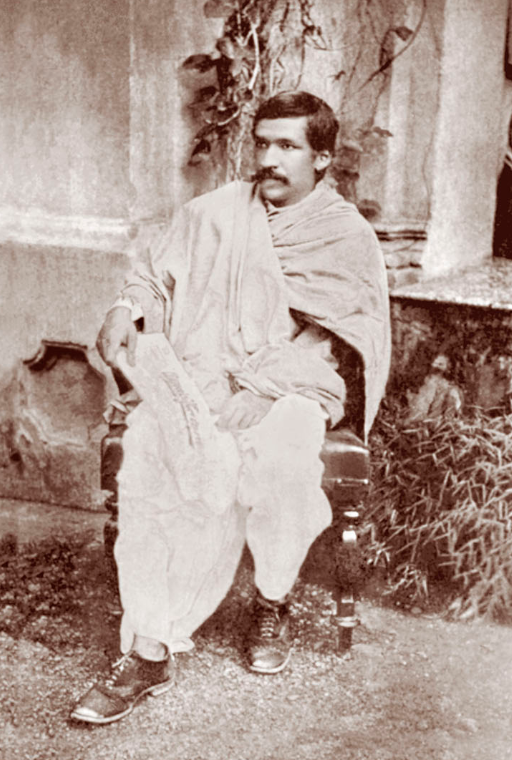
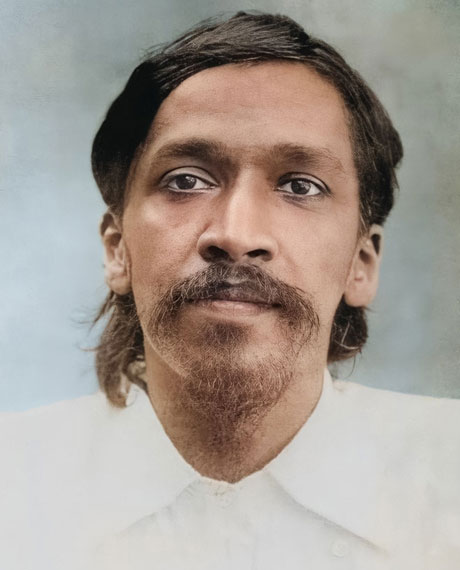
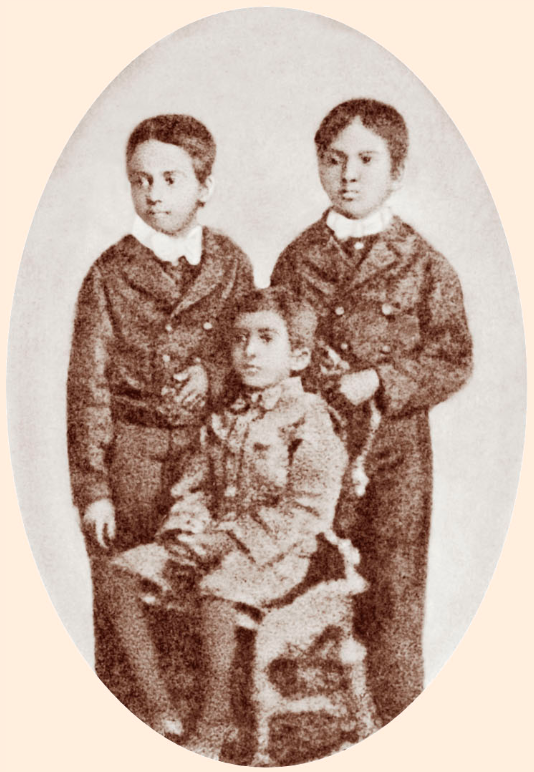
Sri Aurobindo was born in Calcutta on August 15, 1872. At the age of four he was sent, with his two elder brothers Benoybhushan (1867–1947) and Manmohan (1869–1924), to the Loreto Convent School at Darjeeling.
In 1879 Sri Aurobindo’s father, Dr Krishna Dhan Ghose (1844–1892), took his family to England and placed his sons with a clergyman in Manchester for a thoroughly English education; they were not to be allowed to make the acquaintance of any Indian or undergo any Indian influence or be given any religious instruction.
Considered too young to go to school, Sri Aurobindo was tutored at home in Latin, French, history, geography and arithmetic. Almost from the start he took up serious literature, devoting himself mainly to poetry: Shakespeare, Shelley, Keats, etc. The poet was the primary aspect of his personality; none of the other aspects that came later diminished the poet in him.
St. Paul’s School, London
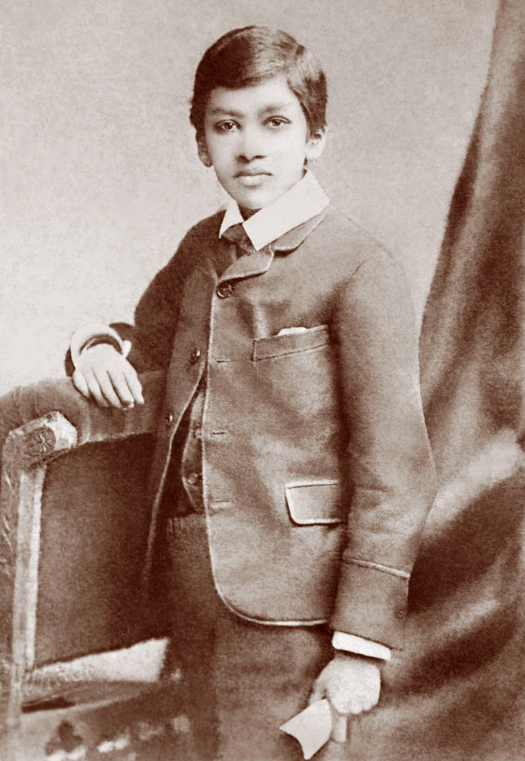
In 1884 Sri Aurobindo was enrolled at St. Paul’s School, London, as a Foundation Scholar (an outstanding student who is granted previlages and exemption from entrance and tuition fees) where he largely studied the classics. Impressed by his Latin, the High Master himself grounded him in Greek and pushed him rapidly into higher classes. A decade later he would remark that of all the boys who had passed through his hands this one was by far the most richly endowed in intellectual capacity.
In his last three years at St. Paul’s (1887–90) Sri Aurobindo spent most of his spare time reading English poetry, literature and fiction, French literature and European history; he also spent much time writing poetry. During this time he also taught himself Italian, some German and a little Spanish in order to read Dante, Goethe and Calderon in the original. It was also a time of great suffering and poverty. As he later noted, ’During a whole year a slice or two of sandwich, bread and butter and a cup of tea in the morning and in the evening a penny saveloy formed the only food.“
– Sri Aurobindo
Last sentence only
CWSA Vol. 36, p. 116
At the age of eleven Aurobindo had already received strongly the impression that a period of general upheaval and great revolutionary changes was coming in the world and he himself was destined to play a part in it. His attention was now drawn to India and this feeling was soon canalised into the idea of the liberation of his own country. But the ”firm decision“ took full shape only towards the end of another four years. It had already been made when he went to Cambridge and as a member and for some time secretary of the Indian Majlis of Cambridge he delivered many revolutionary speeches.… – Sri Aurobindo
Written in the third person
CWSA Vol. 36, p. 32
King’s College Cambridge
In December 1889 Sri Aurobindo stood first in the open examinations for Classical Scholarships to King’s College, Cambridge. In June 1890 he passed the open examination for the Indian Civil Service and in October took up residence at King’s.
For the next two years Sri Aurobindo attended to his classical and ICS studies. He passed the Tripos honors examination in Cambridge in first division and obtained record marks in Greek and Latin in the final examination for the ICS.
At this time the Maharaja of Baroda, Sayaji Rao, was in London. Sri Aurobindo saw him, obtained an appointment in the Baroda Service and returned to India in 1893.
In England he had received, according to his father’s express instructions, an entirely occidental education without any contact with the culture of India and the East. At Baroda he made up the deficiency, learned Sanskrit and several modern Indian languages, assimilated the spirit of Indian civilisation and its forms past and present. – Sri Aurobindo
Written in the third person
CWSA Vol. 36, p. 5–6
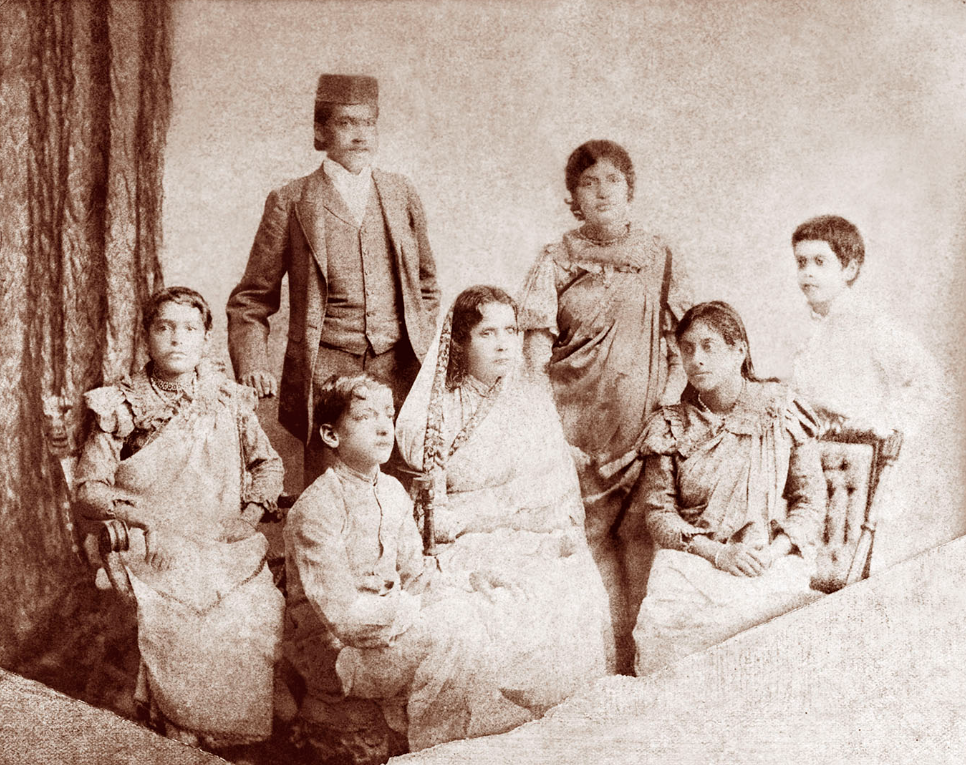
With family members during a visit to Calcutta around 1898.
The others probably include his aunt Lilavati Mitra and his cousins Kumudini, Basanti and Sukumar Mitra.
Baroda
Years of Self-Culture
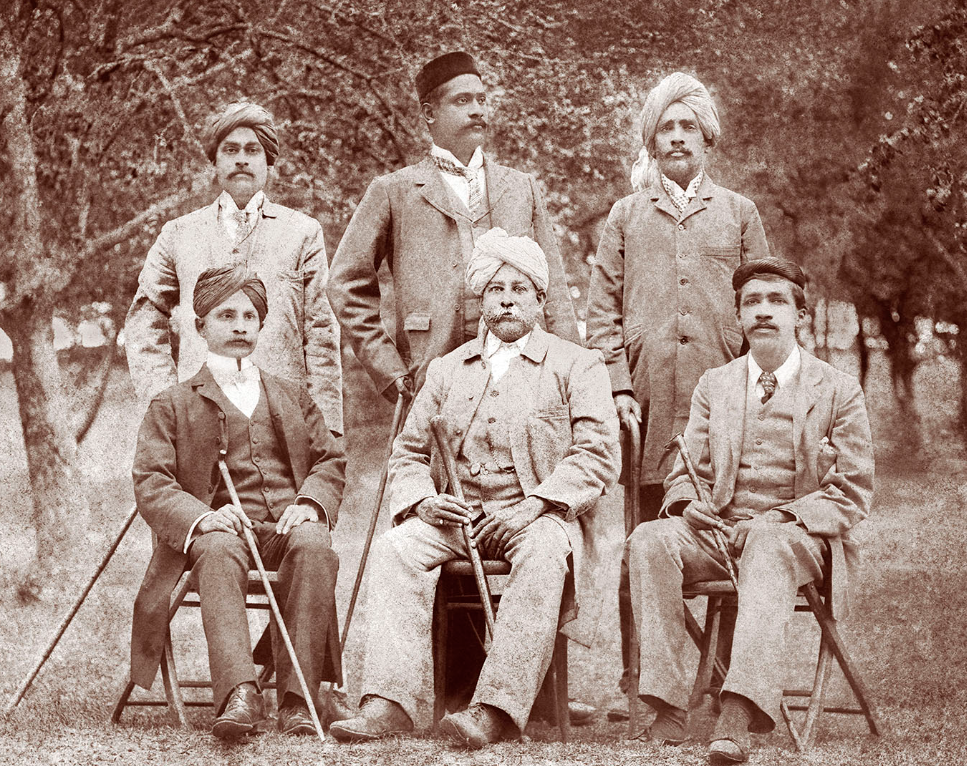
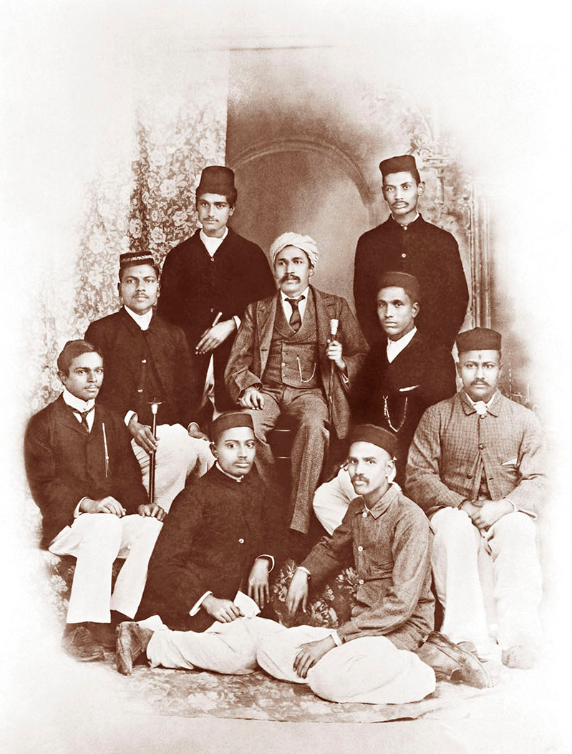
Sri Aurobindo passed thirteen years, from 1893 to 1906, in the Baroda Service, first in the Revenue Department and in secretariate work for the Maharaja, afterwards as Professor of English and, finally, Vice-Principal in the Baroda College. These were years of self-culture, of literary activity—for much of the poetry afterwards published from Pondicherry was written at this time—and of preparation for his future work. – Sri Aurobindo
Written in the third person
CWSA Vol. 36, p. 4
*
In England, apart from English, French and his study of Greek and Latin, Sri Aurobindo also learned German and Italian sufficiently to read Goethe and Dante in the original tongues. He had learned Sanskrit for his ICS and upon his return to India he studied the Upanishads, the Gita and the Indian classical literature in the original. As an officer of state he learned Gujarati and Marathi which made it easier for him to pick up Hindi. He also perfected his Bengali which he began learning in Cambridge and wrote many articles later in his Bengali weekly Dharma.
Baroda
Years of Self-Culture
Sri Aurobindo passed thirteen years, from 1893 to 1906, in the Baroda Service, first in the Revenue Department and in secretariate work for the Maharaja, afterwards as Professor of English and, finally, Vice-Principal in the Baroda College. These were years of self-culture, of literary activity—for much of the poetry afterwards published from Pondicherry was written at this time—and of preparation for his future work. – Sri Aurobindo
Written in the third person
CWSA Vol. 36, p. 4
*
In England, apart from English, French and his study of Greek and Latin, Sri Aurobindo also learned German and Italian sufficiently to read Goethe and Dante in the original tongues. He had learned Sanskrit for his ICS and upon his return to India he studied the Upanishads, the Gita and the Indian classical literature in the original. As an officer of state he learned Gujarati and Marathi which made it easier for him to pick up Hindi. He also perfected his Bengali which he began learning in Cambridge and wrote many articles later in his Bengali weekly Dharma.
He had already in England decided to devote his life to the service of his country and its liberation. He even began soon after coming to India to write on political matters (without giving his name) in the daily press, trying to awaken the nation to the ideas of the future.
– Sri Aurobindo
Written in the third person
CWSA Vol. 36, p. 67
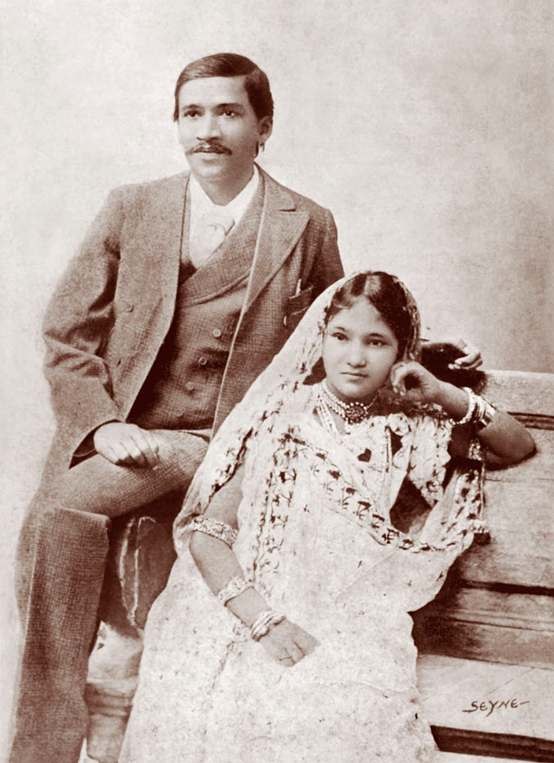
In April 1901 Sri Aurobindo married Mrinalini Bose. In a letter of 30 August 1905 he wrote to her:
”I have three madnesses. The first is this. I firmly believe that the accomplishments, talents, education and means that God has given me, are all His.…
The second madness which has recently seized hold of me is: I must somehow see God.… If He exists, there must be ways to perceive His presence, to meet Him. However arduous the way, I am determined to follow that path.
My third madness is that other people look upon the country as an inert piece of matter, stretch of fields and meadows, forests and rivers. To me She is the Mother.…“
Nirodbaran, Sri Aurobindo for All Ages, 1994 ed, p. 53
Sri Aurobindo was loved and revered by his students, as much for his profound knowledge and original way of teaching, as for his magnetic personality and gentle, gracious manners.
Nirodbaran, Sri Aurobindo for All Ages, 1994 ed, p. 26
Pranayama
Sri Aurobindo began Yoga around 1904 with Pranayama as explained to him by a friend, a disciple of Swami Brahmananda of Chandod. Some remarkable results came with the practice:
”First, I felt a sort of electricity all around me. Secondly, there were some visions of a minor kind. Thirdly, I began to have a very rapid flow of poetry.… Fourthly, it was at the time of Pranayama practice that I began to put on flesh. Earlier I was very thin. My skin also began to be smooth and fair.… It was at this time that I adopted a vegetarian diet. That gave me lightness and some purification.“ – Sri Aurobindo
M. P. Pandit, Reminiscenses and Anecdotes of Sri Aurobindo, 1966 ed., p. 141
I used to do it for five or six hours in the day, three hours in the morning and two in the evening. The mind worked with great illumination and power. At that time I used to write poetry. Usually I wrote five to eight or ten lines per day, about 200 lines in a month. After the Pranayama practice I could write 200 lines within half an hour. Formerly my memory was dull, but afterwards when the inspiration came, I could remember the lines in their order and write them down correctly at any time. Along with these enhanced functionings I could see an electrical activity all around the brain, and I could feel that it was made up of a subtle substance. I could feel everything as the working of that substance. – Sri Aurobindo
A. B. Purani, Evening Talks, 1995 ed., pp. 168–69
When I turned to the Yoga and resolved to practise it and find out if my idea was right, I did it in this spirit and with this prayer to Him, ”If Thou art, then Thou knowest my heart. Thou knowest that I do not ask for Mukti, I do not ask for anything which others ask for. I ask only for strength to uplift this nation, I ask only to be allowed to live and work for this people whom I love and to whom I pray that I may devote my life.“ – Sri Aurobindo
CWSA Vol. 8, pp. 9–10
The outbreak of the agitation against the partition of Bengal in 1905 gave Sri Aurobindo the opportunity to give up the Baroda Service and join openly in the political movement. He left Baroda in 1906 and went to Calcutta as Principal of the newly-founded Bengal National College. – Sri Aurobindo
Written in the third person
CWSA Vol. 36, p. 6
As editor of the Calcutta daily newspaper Bande Mataram:
Sri Aurobindo’s first preoccupation was to declare openly for complete and absolute independence as the aim of political action in India and to insist on this persistently in the pages of the journal; he was the first politician in India who had the courage to do this in public and he was immediately successful. – Sri Aurobindo
Written in the third person
CWSA Vol. 36, pp. 55–56
The journal [Bande Mataram] declared and developed a new political programme for the country as the programme of the Nationalist party.… – Sri Aurobindo
CWSA Vol. 36, p. 56
Even my action in giving the movement in Bengal its militant turn or founding the revolutionary movement is very little known.
– Sri Aurobindo
CWSA Vol. 35, p. 26
The greatest thing done in those years was the creation of a new spirit in the country. In the enthusiasm that swept surging everywhere with the cry of Bande Mataram ringing on all sides men felt it glorious to be alive and dare and act together and hope.…
– Sri Aurobindo
CWSA Vol. 36, p. 59
His [Sri Aurobindo’s] idea was to capture the Congress and to make it an instrument for revolutionary action instead of a centre of a timid constitutional agitation which would only talk and pass resolutions and recommendations to the foreign Government.…
– Sri Aurobindo
Written in the third person
CWSA Vol. 36, pp. 52–53
The Nirvana Experience—I
In January 1908 Sri Aurobindo met Vishnu Bhaskar Lele, a Maharashtrian Yogi in Baroda. They spent three days together in a friend’s house in complete isolation. It was here that he had his first major spiritual experience. Lele told him:
”Sit in meditation, but do not think, look only at your mind; you will see thoughts coming into it; before they can enter throw these away from your mind till your mind is capable of entire silence.“ I had never heard before of thoughts coming visibly into the mind from outside, but I did not think either of questioning the truth or the possibility, I simply sat down and did it. In a moment my mind became silent as a windless air on a high mountain summit and then I saw one thought and then another coming in a concrete way from outside; I flung them away before they could enter and take hold of the brain and in three days I was free. From that moment, in principle, the mental being in me became a free Intelligence, a universal Mind … a receiver of knowledge from all the hundred realms of being and free to choose what it willed in this vast sight-empire and thought-empire. – Sri Aurobindo
Last paragraph only
CWSA Vol. 35, p. 244
Sri Aurobindo was the first political leader in India to openly pen down the idea of complete independence in his newspaper Bande Mataram. His political involvement in the Indian national movement was short, but had a great impact over the nation. He was involved in drafting the fourfold objectives of the national movement: Swaraj [self-governance for India], Swadesh [the motherland], boycott [of British institutions], and national education.
In 1910, assured of the ultimate success of the freedom movement and in answer to a command from above, Sri Aurobindo withdrew from political activities and plunged into another tapasya, a revolution of inner dimension, that was aimed at freeing the entire human race from the clutches of ego and desire, ignorance, suffering and falsehood by the strength of True Knowledge.
British Govt realizing him as a threat to the empire termed him as the “Most dangerous man”. He was jailed under false charges by the British Government, but was later acquitted after one year. While in prison he had another spiritual experience ‘Vasudeva Sarvam Iti‘ – seeing the Divine in everything.
In 1910, assured of the ultimate success of the freedom movement and in answer to a command from above, Sri Aurobindo withdrew from political activities and plunged into another tapasya, a revolution of inner dimension, that was aimed at freeing the entire human race from the clutches of ego and desire, ignorance, suffering and falsehood by the strength of True Knowledge.
In Pondicherry, with the help of The Mother (Mirra Alfassa), his spiritual collaborator, he founded Sri Aurobindo Ashram as a place to practice his Integral Yoga. After years of Tapasya, he declared that ‘mind is not final’, ‘man is an intermediate being’, a new race will appear on earth. Sri Aurobindo brought down the New Consciousness – Supramental Consciousness, on Earth. This New Consciousness will free humanity from ego, suffering and ignorance and will eventually manifest in the evolution of a new species – Superman.
During this period of his Yoga spanning 40 years, Sri Aurobindo always kept an eye on India’s freedom movement and major developments around the world and applied silent spiritual force where necessary. One such example was Cripps Mission. Sri Aurobindo had sent an emissary to the then Congress Working Committee to accept the Cripps proposal. Unfortunately, his proposal was not accepted. Had they listened to him, our nation would have remained united.
Sri Aurobindo wrote exhaustively on the realisation of oneness of humanity, transformation of nature, and the discovery of the Supreme Divine Reality present within us. His work is a revolution in the inner dimension. Some of his major works are Life Divine, Savitri, Synthesis of Yoga, Human Cycle and Ideal of Human Unity, etc. These books give us his insights for bringing a permanent solution to man’s existential crisis of death, disease and old-age – bringing the ultimate perfection in man.
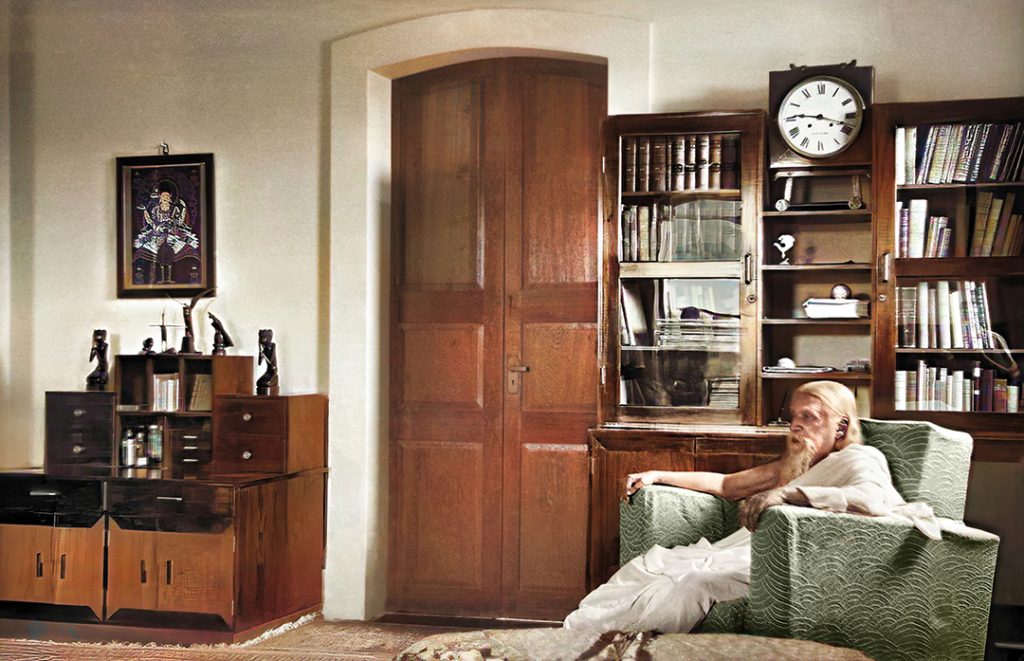
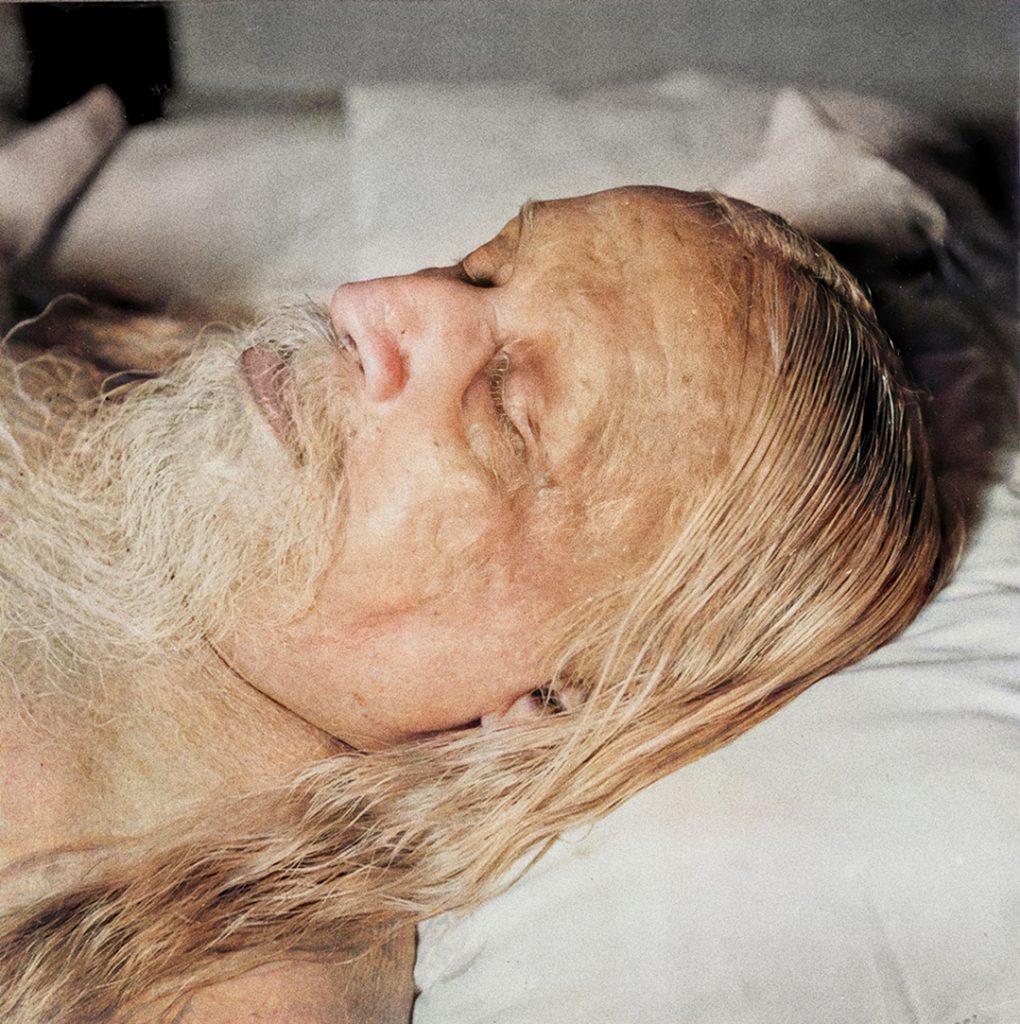
Sri Aurobindo left his physical body on December 5th, 1950.
Sri Aurobindo
Sri Aurobindo was born in Kolkata on 15 August 1872. From his childhood, he was given education in England as his father wanted his children to be brought up in a Western way. During his 14 years in England, he gained a deep insight into the culture of ancient and modern Europe. Through his father’s letters he came to know about the British atrocities in India and resolved to free India. To serve his Motherland, he deliberately disqualified himself from the ICS exam, despite securing a top rank.
In 1893, Sri Aurobindo returned to India with a completely occidental education. He now turned his attention towards the wisdom and truth of India, learned Sanskrit and several modern Indian languages, and assimilated the spirit of Indian civilization. He took active part in Indian freedom movement, wrote nationalistic articles in magazines and newspapers to ignite the sleeping nation, which caused mass uprising. British Govt realizing him as a threat to the empire termed him as the “Most dangerous man”. He was the the first person to demand Purna Swaraj (complete independence) in 1906.
Sri Aurobindo took up Yoga to free his motherland and in 1908 had his first spiritual experience of the ‘Silent Brahman’. He was jailed under false charges by the British Government, but was later acquitted after one year. While in prison he had another spiritual experience ‘Vasudeva Sarvam Iti‘ – seeing the Divine in everything.
In 1910, assured of the ultimate success of the freedom movement and in answer to a command from above, Sri Aurobindo withdrew from political activities and plunged into another tapasya, a revolution of inner dimension, that was aimed at freeing the entire human race from the clutches of ego and desire, ignorance, suffering and falsehood by the strength of True Knowledge. In Pondicherry, with the help of The Mother (Mirra Alfassa), his spiritual collaborator, he founded Sri Aurobindo Ashram as a place to practice his Integral Yoga. After years of Tapasya, he declared that ‘mind is not final’, ‘man is an intermediate being’, a new race will appear on earth. Sri Aurobindo brought down the New Consciousness – Supramental Consciousness, on Earth. This New Consciousness will free humanity from ego, suffering and ignorance and will eventually manifest in the evolution of a new species – Superman. During this period of his Yoga spanning 40 years, Sri Aurobindo always kept an eye on India’s freedom movement and major developments around the world and applied silent spiritual force where necessary. One such example was Cripps Mission. Sri Aurobindo had sent an emissary to the then Congress Working Committee to accept the Cripps proposal. Unfortunately, his proposal was not accepted. Had they listened to him, our nation would have remained united. Sri Aurobindo wrote exhaustively on the realisation of oneness of humanity, transformation of nature, and the discovery of the Supreme Divine Reality present within us. His work is a revolution in the inner dimension. Some of his major works are Life Divine, Savitri, Synthesis of Yoga, Human Cycle and Ideal of Human Unity, etc. These books give us his insights for bringing a permanent solution to man’s existential crisis of death, disease and old-age – bringing the ultimate perfection in man.
Sri Aurobindo left his physical body on December 5th, 1950.
Complete works of Sri Aurobindo can be found at: https://www.sriaurobindoashram.org/sriaurobindo/writings.php
Support the Ashram’s Work
Help preserve and share the teachings of Sri Aurobindo & The Mother. Your contribution supports educational programs, library archives, and community activities.